Case study · Metro Atlanta Street Hockey Association · 2026
One sign-in, four sites, built for the rink
The Metro Atlanta Street Hockey Association has played ball hockey in Atlanta since 1976. This fall it moved its whole season onto a platform I designed, built and now run: registration, live scoring, standings, Sunday scrimmages, 50 years of history and a live draft night.
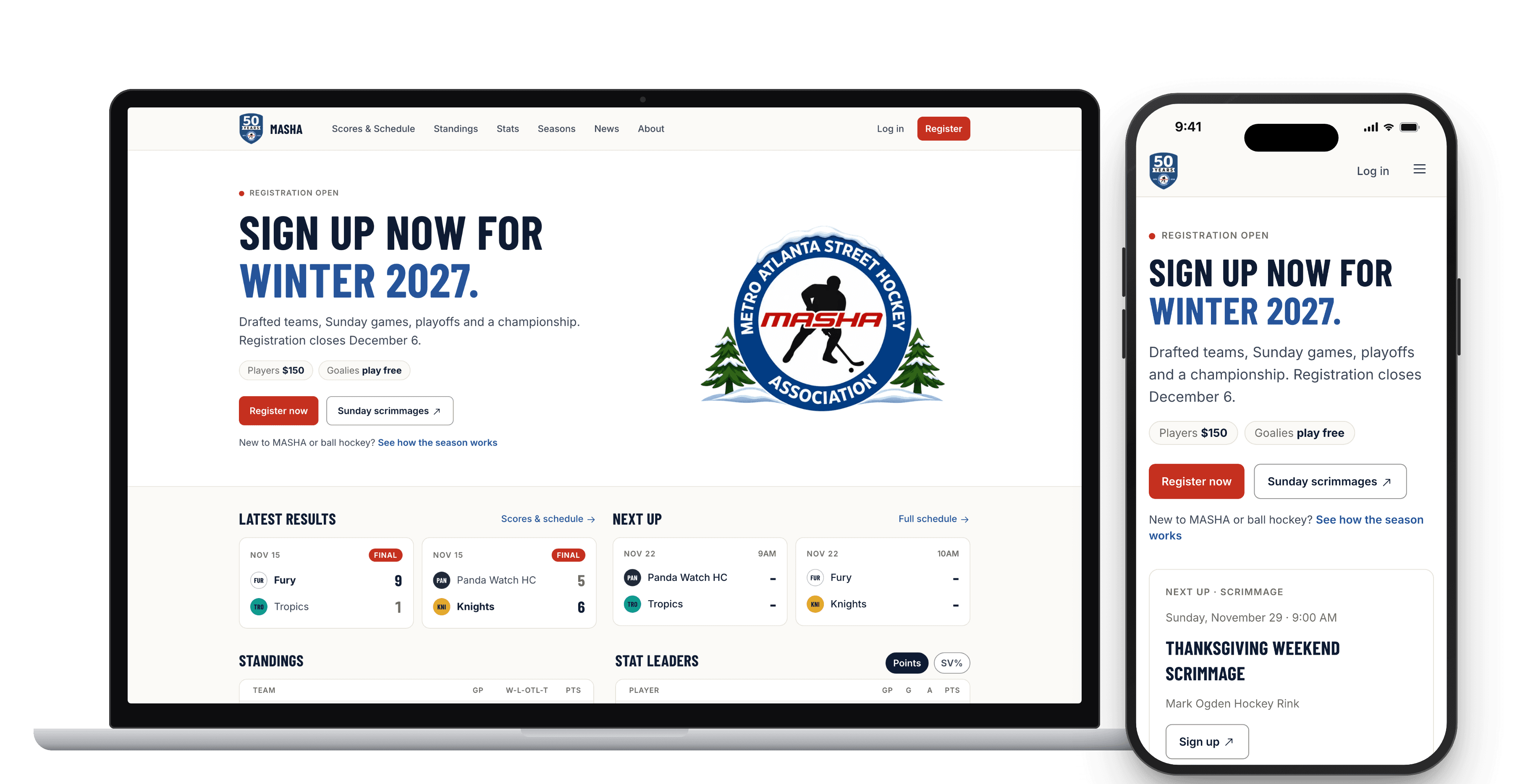
- production sites on one codebase
- 4production sites on one codebase
- first commit to a mid-season cutover
- 7 monthsfirst commit to a mid-season cutover
- seasons online, back to 2005
- 63seasons online, back to 2005
- automated backend tests
- 380automated backend tests
- a month to run
- ~$36a month to run
- My role
- Product owner, designer, technical lead and operator. The only person on the build.
- Timeline
- April to October 2026. Live since October 25, 2026.
- Stack
- Next.js, React, Tailwind, Firebase, Vercel, Claude Code.
The problem
A goal at the rink was typed three times
Every Sunday, a goal scored at the rink went on a paper scoresheet. Days later someone typed it into a Google Sheet, then into a WordPress page. Standings were posted by hand. Scrimmage RSVPs lived in a separate app, registrations in another sheet, and waivers on paper. The stat sheets and the box scores often disagreed, and nobody could say which was right.
Fifty years of league history was in worse shape: scattered across old exports, recaps and pages, with whole seasons missing.
The league needed one source of truth. A goal entered at the rink should reach the public standings without anyone typing it twice. It also had to work within real limits:
- Volunteer-run. No staff, no budget for software, and no one to maintain anything complicated.
- Phone-first. Players check scores on the couch; the scorer works on a phone, standing at the boards.
- Real personal data. Waivers, birthdays, and minors who need a guardian’s consent.
- A season in progress. The switch had to happen mid-season, without missing a game.
Who it's for
Five people with very different jobs
Each one gets their own site, but it’s one program underneath, one account and one database. Sign in once and it works everywhere.
| Who | Where | What they need |
|---|---|---|
| Players and fans | mashahockey.com | Scores, standings, stats and their own career history |
| Members | mashahockey.com, app.mashahockey.com | Join, register, pay, and RSVP for Sunday scrimmage |
| The scorer | admin.mashahockey.com | Score a game on a phone, fast, even with a weak signal |
| League admins | admin.mashahockey.com | Run seasons, rosters, news, awards and the inbox |
| Team captains | draft.mashahockey.com | Draft their team live on draft night |
Live scoring
Paper scoresheets were the root of the problem, so live scoring came first
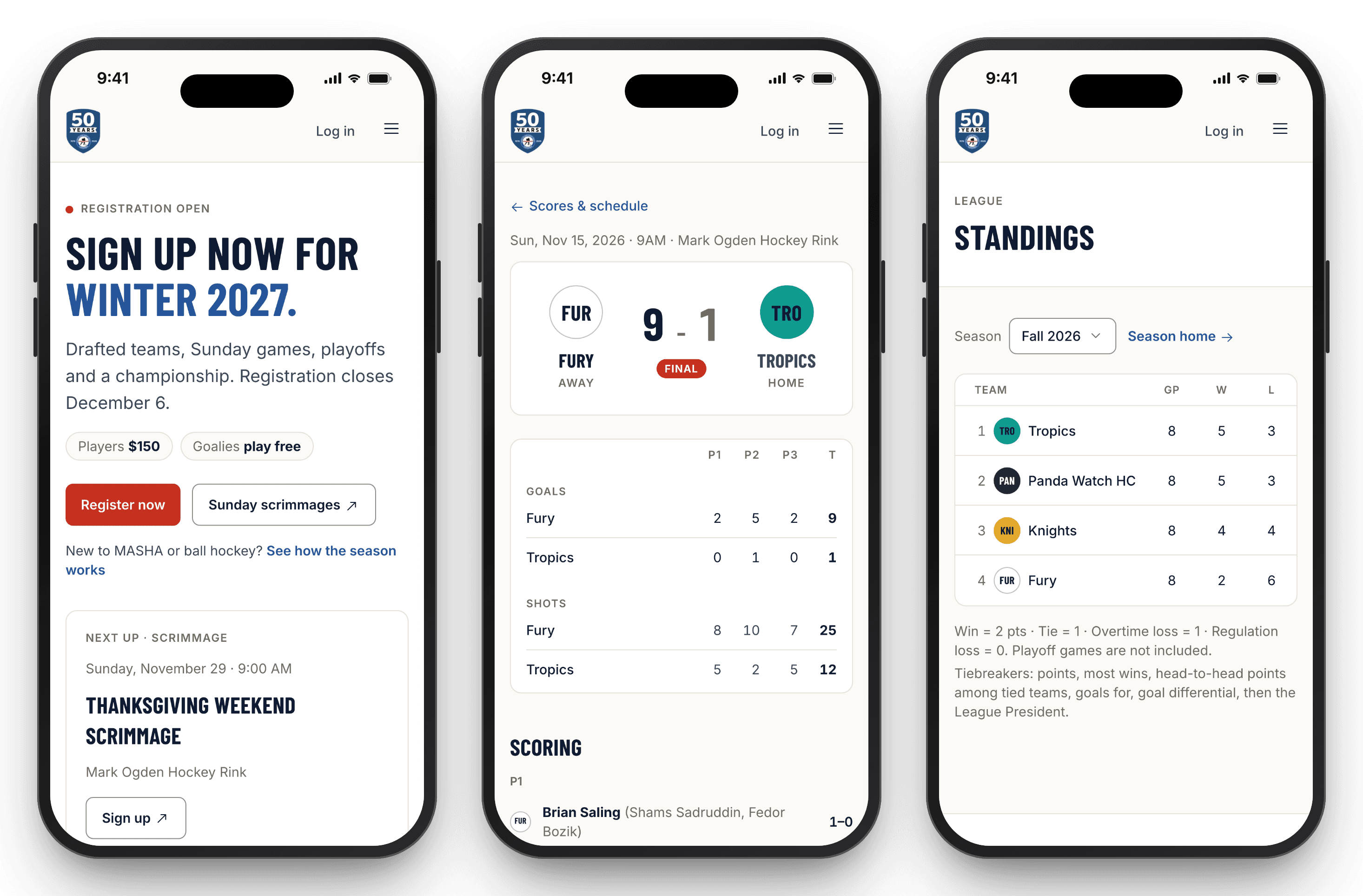
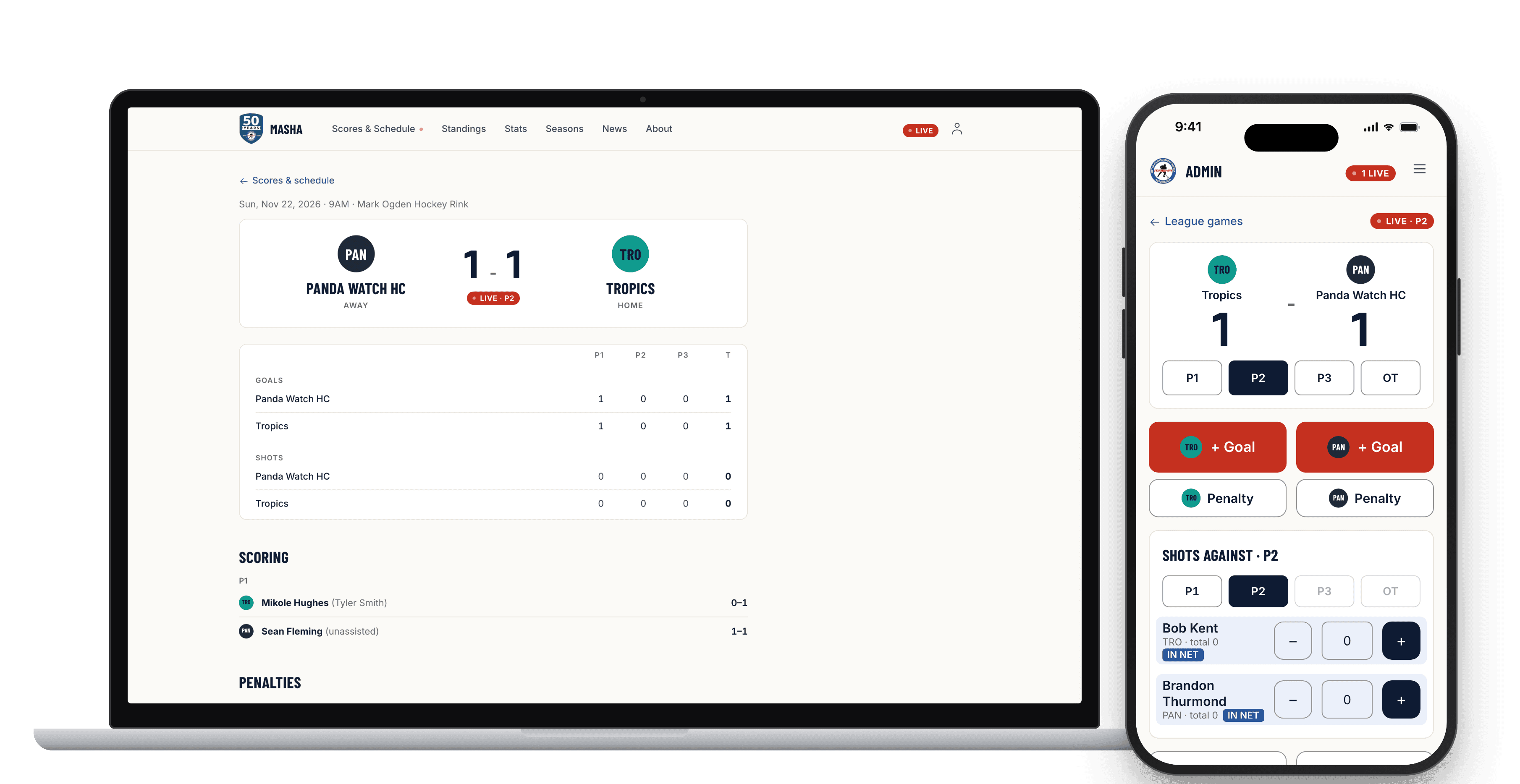
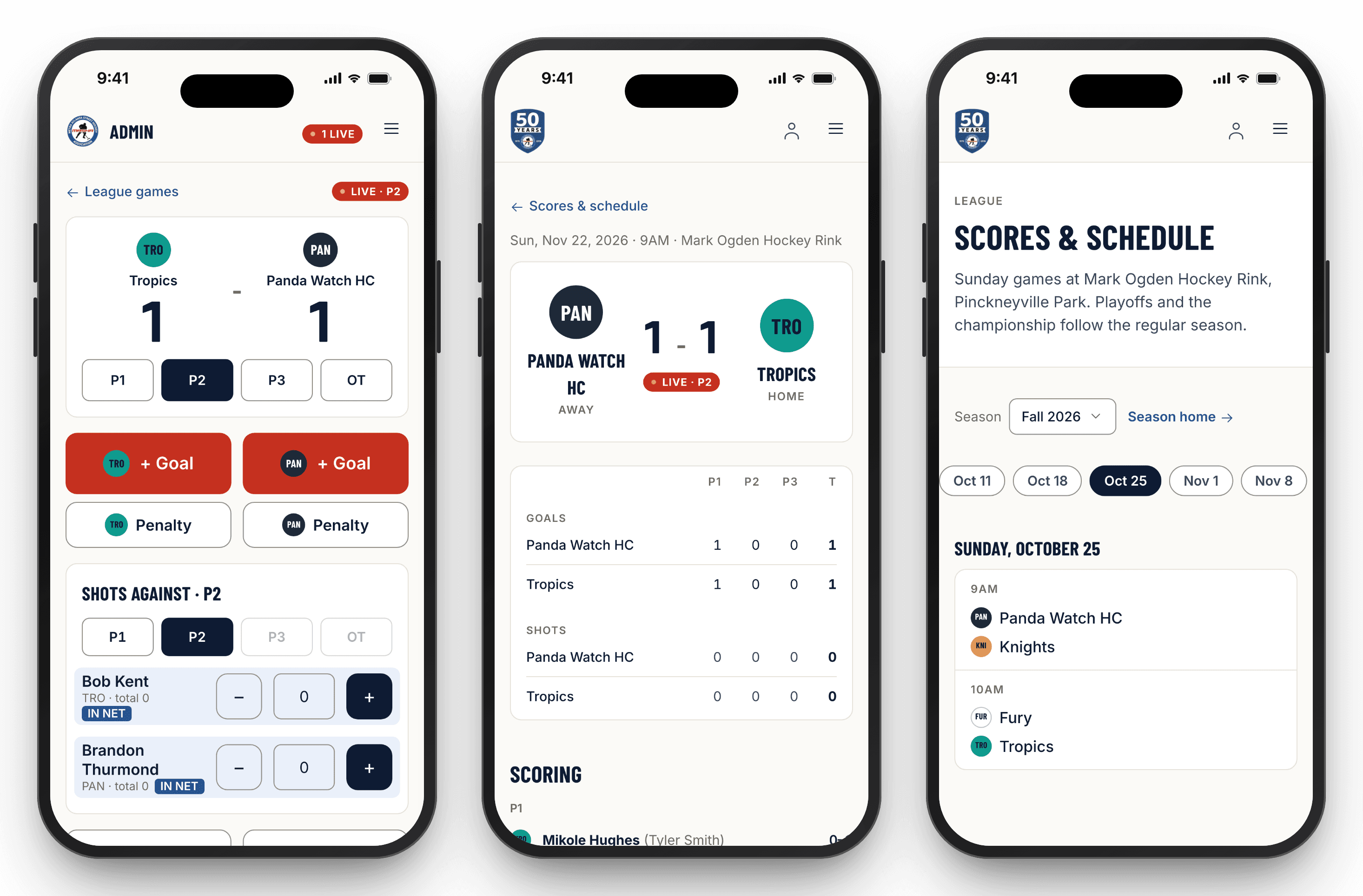
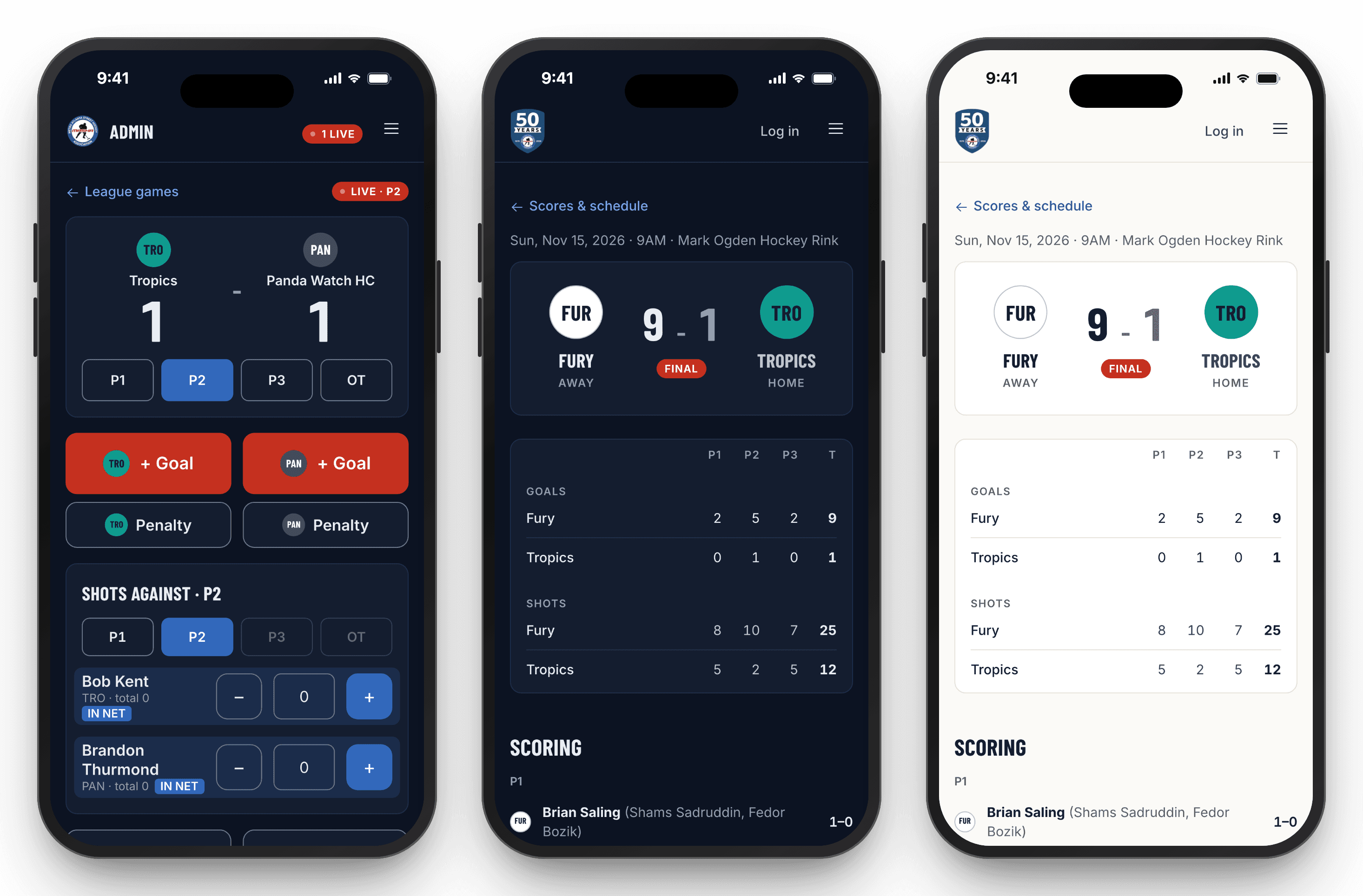
The scorer is built for one person standing at the boards with a phone. The lineup comes from the roster with jersey numbers. Goals, assists and penalties are a couple of taps, with type-to-search when a sub is playing. Shots are counted per goalie, by period.
The decision that mattered most: every tap saves on the phone first. The app sends changes in the background. If a send fails, a “Not sent” bar offers Retry, and nothing typed at the rink is lost. When the scorer finalizes the game, standings and stats are recalculated and the public site refreshes within moments.
Mistakes happen, so a finished game can be reopened to fix. The public site keeps showing it as final while the fix is made. Paper is now the backup. Live scoring has been trusted since the first game.
Draft night
A fourth site, just for draft night
The league drafts new teams every season, and the draft used to run on a spreadsheet. Colours marked who picked when. The salary cap was worked out by hand.
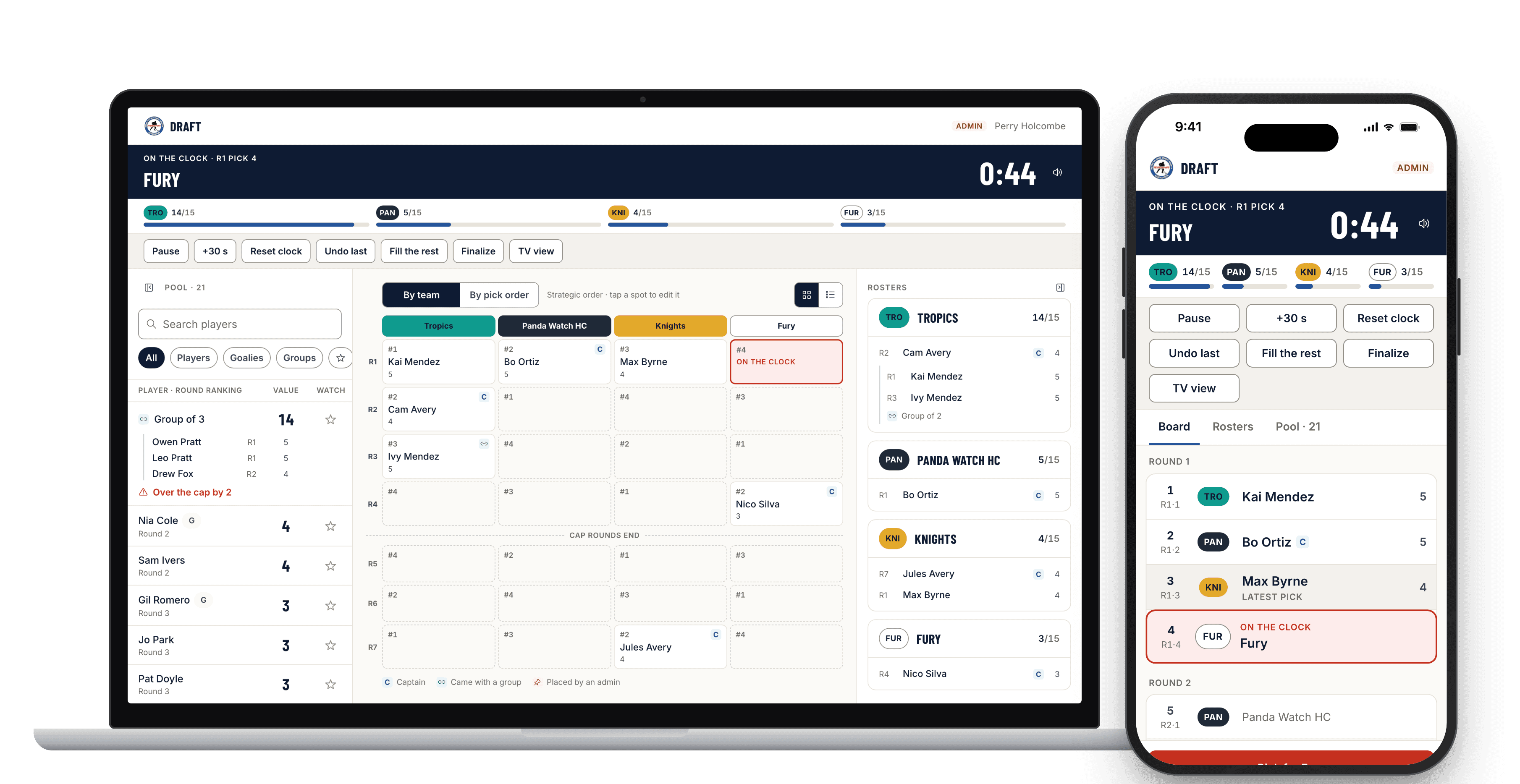
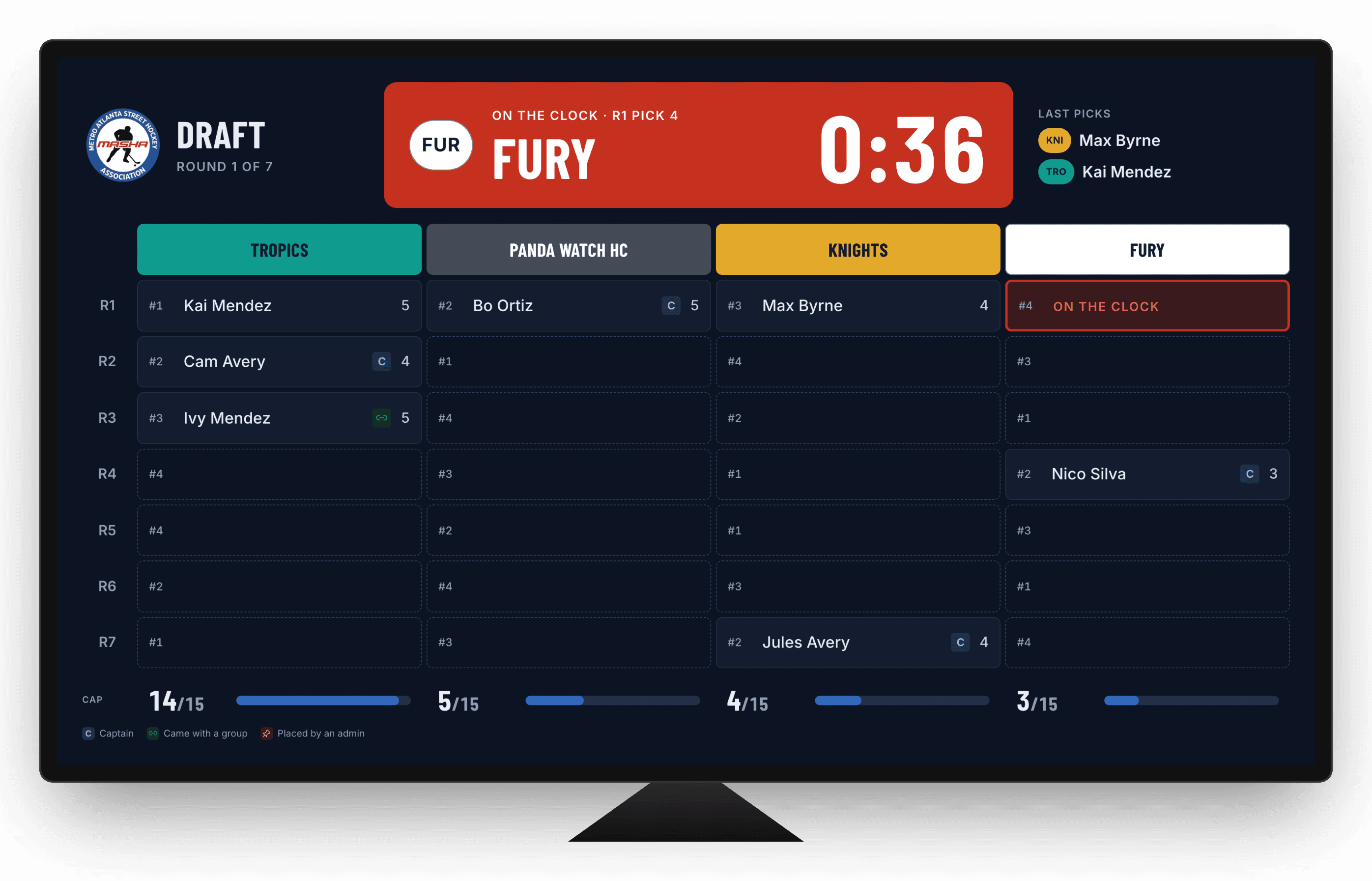
Captains now pick from their phones on their turn. A big-screen view shows the room the clock, the board and every team’s cap. When the last pick is in, one button turns the board into the season’s rosters. The rules were the hard part, and I wrote them down before anything was built:
- Strategic pick order. Every team gets each pick slot once per block of rounds, and nobody picks last and then first back to back.
- Groups. Players who asked to play together are drafted together. Pick one and the group follows, seated by their expected round.
- A salary cap over the early rounds, with the full value of a group counted when it’s picked.
- One clock for everyone, synced to the server so every phone and the TV show the same time.
- Overrides with a paper trail. A rule break stops a captain. An admin can override it, but has to give a reason, and the reason goes in the log.
To test the rules, I used the real Fall 2026 draft board: the rules engine replays it pick by pick.
Fifty years of history
57 seasons rebuilt into one archive
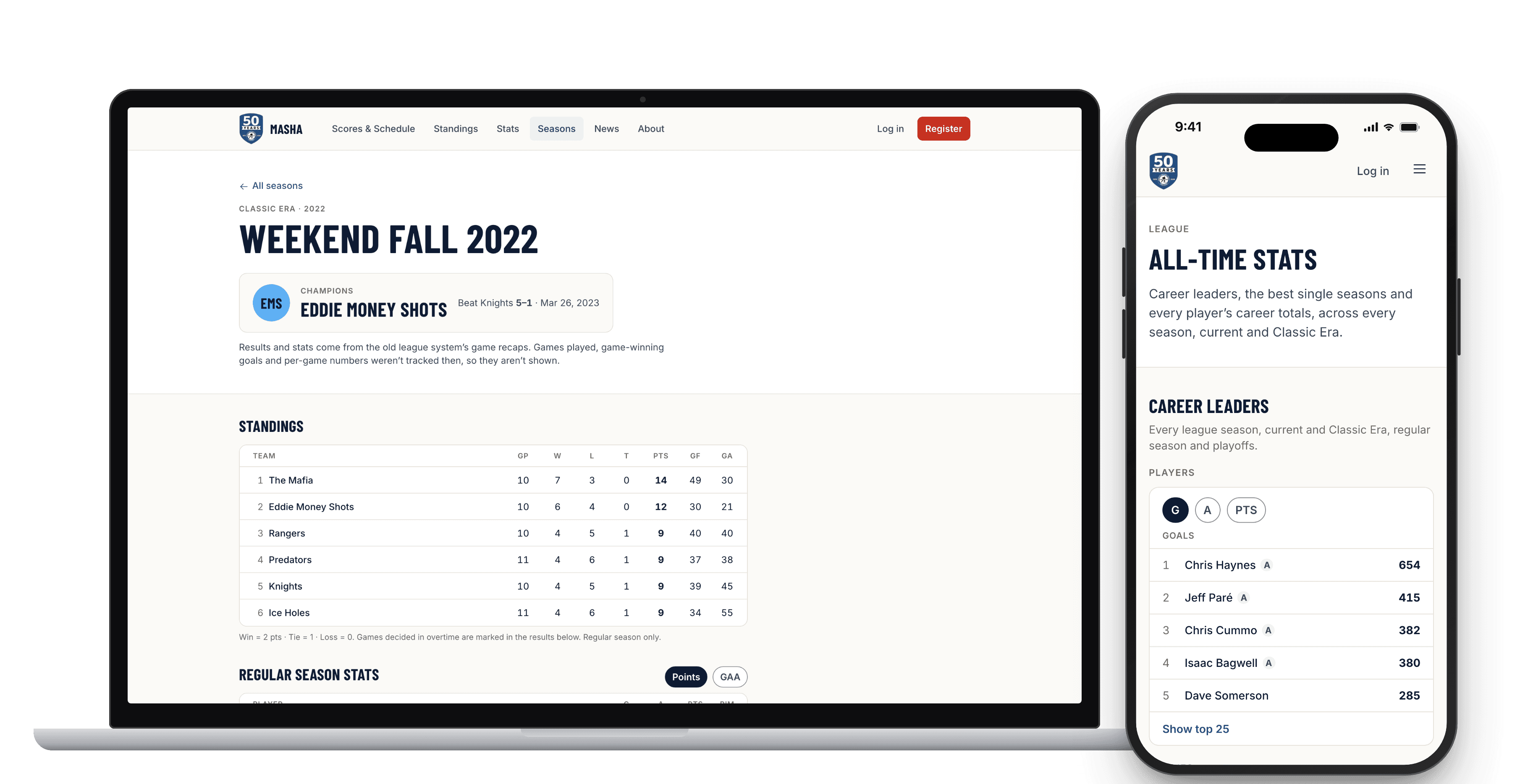
The old records were scattered across recaps, pages and exports. I rebuilt 57 seasons, from 2005 to 2022, into one archive with standings, champions, rosters, box scores and goal times wherever they survived. Only stats and results were used; payment, injury and insurance files were never opened.
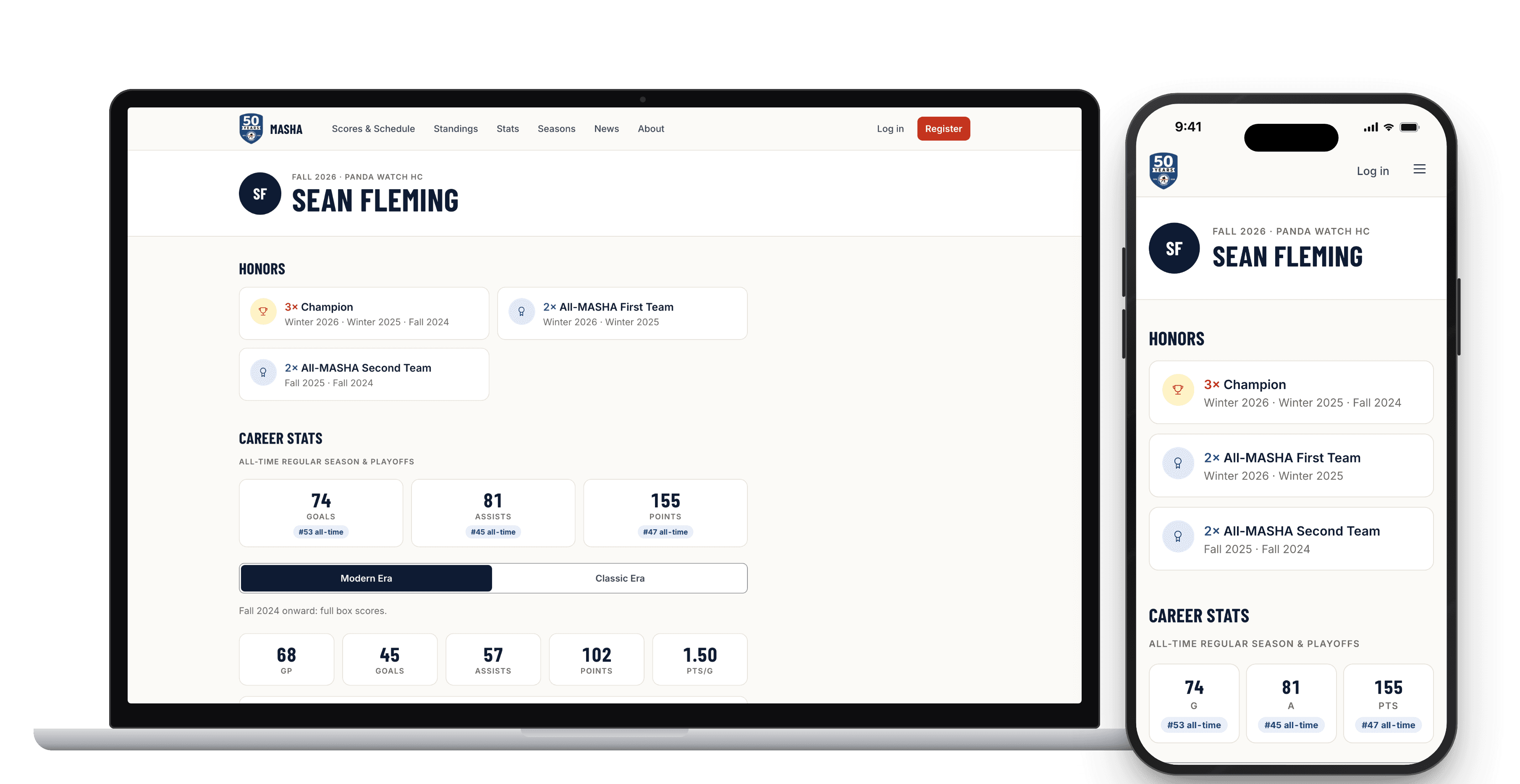
Old seasons share the same page layout and addresses as new ones. So every player has a single career page that covers both eras: honors, teams and totals from 2005 to today. Some records are gone for good, and the site says so plainly rather than guessing.
Joining and scrimmage
Signing up used to take several tools. Now it's one flow.
- No passwords. People sign in with a code sent to their email.
- Waiver first. Everyone accepts the liability waiver before they play, and the site records exactly which version they agreed to. A 16 or 17 year old gets a parent or guardian section.
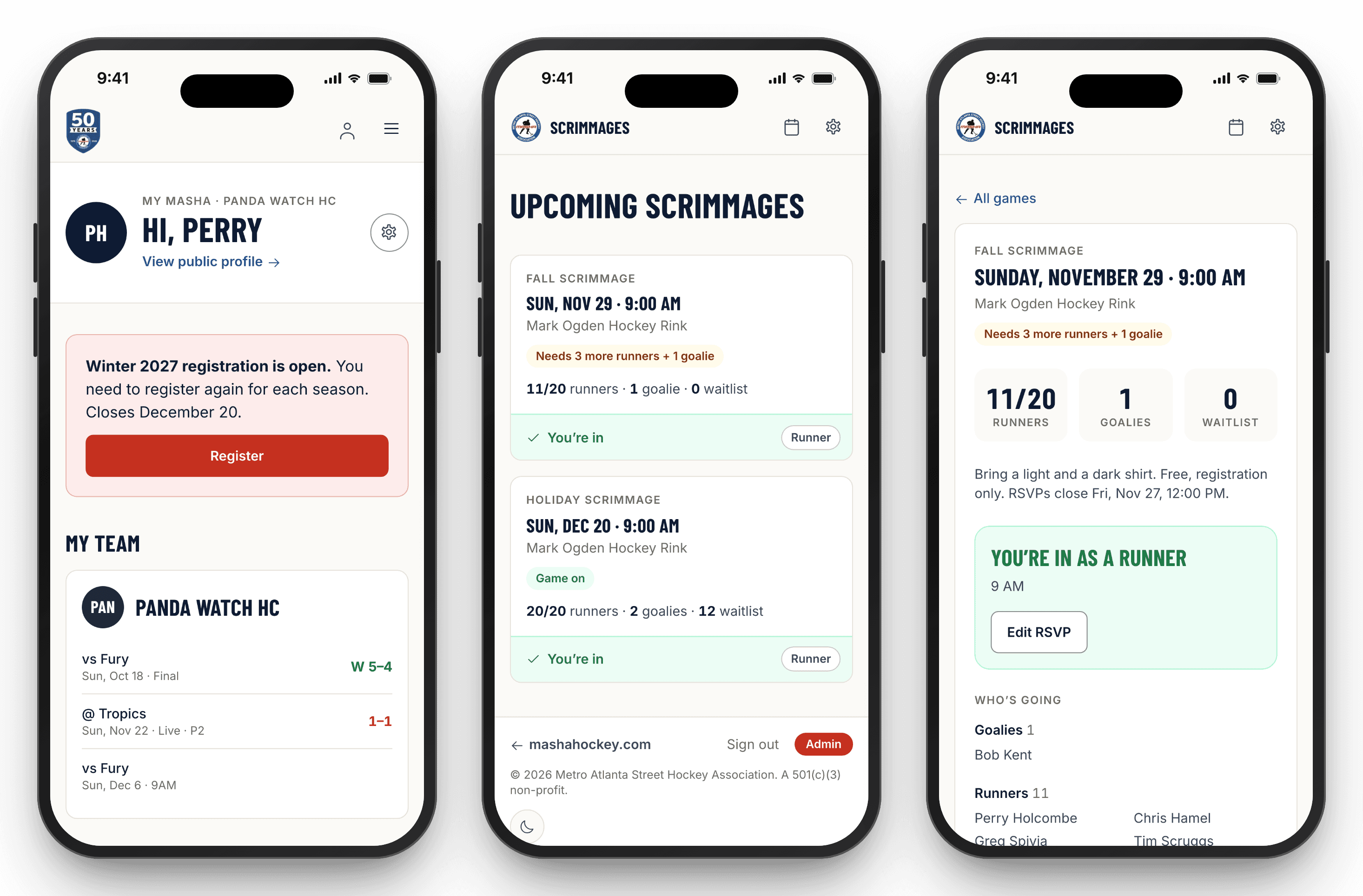
- Register and pay for a season in one go, then see your team, your next game and your payment status in My MASHA.
- Sunday scrimmage has its own app: RSVP as a runner or a goalie, join a waitlist when it’s full, and big turnouts split into a 9 AM and a 10 AM game.
Design and accessibility
One design system, written down as a rulebook
All four sites share one design system: colours, type, spacing, and how every badge, chip and table behaves. Every screen was designed at phone width first, then scaled up.
Accessibility was part of the build, not a fix at the end. The sites were checked against WCAG rules, and I did a full VoiceOver pass on iPhone before calling the work done.
How it's built
Vercel serves the pages. Firebase holds the data and makes every change.
It’s one Next.js app that shows a different site depending on the web address.
- Every change goes through the backend. A goal, an RSVP or a draft pick is a request to one of about 100 Cloud Functions. Each one checks who’s asking and what the rules allow, saves the change, and logs it. The browser never writes league data directly.
- One copy of the league math. Standings, tie-breaks, stats, playoffs and draft rules live in one shared package. The website and the backend use the same code, so they can’t disagree.
- Fast by default. Public pages are built ahead of time and refreshed when a game is finalized. Only live things, like a game in progress or the draft board, listen to the database.
- Tested. 380 backend tests run against a local copy of Firebase, and every change is type-checked, linted and fully built before it’s saved.
Shipping it
A rebuild is easy to start and hard to switch on
- A full test copy. A separate Firebase project and code branch let me try everything with test accounts before it touched real data.
- Data rules up front. When an old stat sheet disagreed with a box score, the box score won. Corrections were kept apart from the imported data, so re-importing could never undo a fix.
- Cutover on October 25, 2026, in the middle of the Fall season, with no missed games.
- Privacy as a rule, not a setting. Personal details never appear on public pages and never go into the code repository.
Running it is part of the job too:
- Alerts. If an email fails to send or someone keeps guessing the scorer PIN, the league inbox gets an alert.
- Cost. Search and AI crawlers opening thousands of archive pages pushed hosting past the free tier. I blocked 23 crawlers and stopped building test versions on every change, since builds were 73% of the bill. The whole platform now runs for about $36 a month.
- Releases. Changes go to the test copy first, and ship once or twice a day in batches.
Building with AI
Claude Code as my engineering partner, run like a team
I made the product and data decisions and wrote the rules and acceptance criteria. Claude Code wrote most of the code. I reviewed it, tested it on real phones at real games, and decided what shipped. What made that work was treating it like running a team:
- Written rules. A design rulebook, data rules and a handoff document meant every working session started with the same context.
- Standing guardrails. Nothing went to production, and nothing was committed, without my say-so.
- Tests as the safety net. The test suites and the replay of a real draft caught regressions before players did.
- Small, reviewable steps. 818 commits from April 17 to November 20, 2026.
Outcomes
What changed for the league
- No more re-typing. A goal entered at the rink reaches the public standings within moments.
- One record per player, covering 2005 to today.
- One sign-up flow with the waiver, registration and payment together.
- Draft night on phones and a TV, instead of a spreadsheet.
- About $36 a month to run four sites.